# Android
-## Build with Android Studio
+## Build GUI binding using Android Studio
Import the `examples/llama.android` directory into Android Studio, then perform a Gradle sync and build the project.
-
+
This Android binding supports hardware acceleration up to `SME2` for **Arm** and `AMX` for **x86-64** CPUs on Android and ChromeOS devices.
It automatically detects the host's hardware to load compatible kernels. As a result, it runs seamlessly on both the latest premium devices and older devices that may lack modern CPU features or have limited RAM, without requiring any manual configuration.
A minimal Android app frontend is included to showcase the binding’s core functionalities:
-1. **Parse GGUF metadata** via `GgufMetadataReader` from either a `ContentResolver` provided `Uri` or a local `File`.
-2. **Obtain a `TierDetection` or `InferenceEngine`** instance through the high-level facade APIs.
-3. **Send a raw user prompt** for automatic template formatting, prefill, and decoding. Then collect the generated tokens in a Kotlin `Flow`.
+1. **Parse GGUF metadata** via `GgufMetadataReader` from either a `ContentResolver` provided `Uri` from shared storage, or a local `File` from your app's private storage.
+2. **Obtain a `InferenceEngine`** instance through the `AiChat` facade and load your selected model via its app-private file path.
+3. **Send a raw user prompt** for automatic template formatting, prefill, and batch decoding. Then collect the generated tokens in a Kotlin `Flow`.
-For a production-ready experience that leverages advanced features such as system prompts and benchmarks, check out [Arm AI Chat](https://play.google.com/store/apps/details?id=com.arm.aichat) on Google Play.
+For a production-ready experience that leverages advanced features such as system prompts and benchmarks, plus friendly UI features such as model management and Arm feature visualizer, check out [Arm AI Chat](https://play.google.com/store/apps/details?id=com.arm.aichat) on Google Play.
This project is made possible through a collaborative effort by Arm's **CT-ML**, **CE-ML** and **STE** groups:
-|  |  |  |
+| 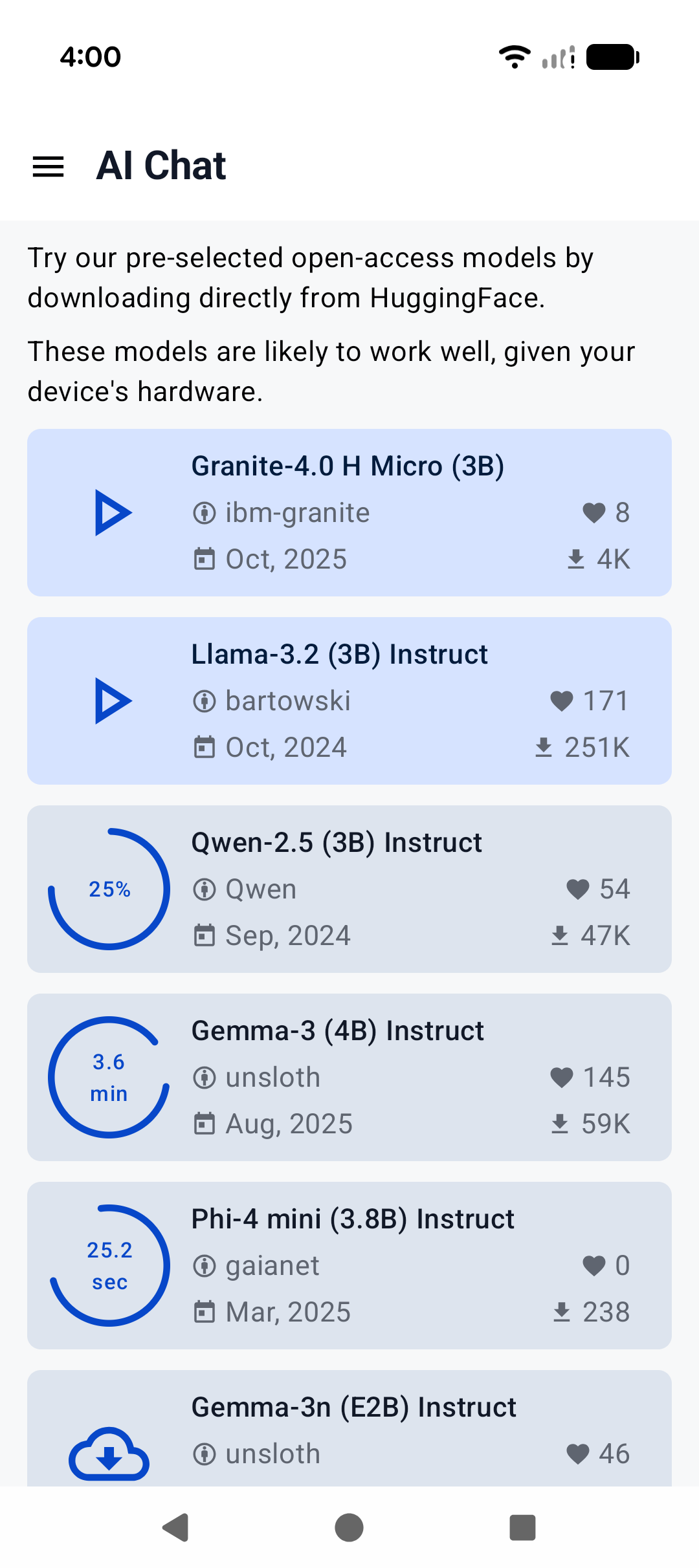 | 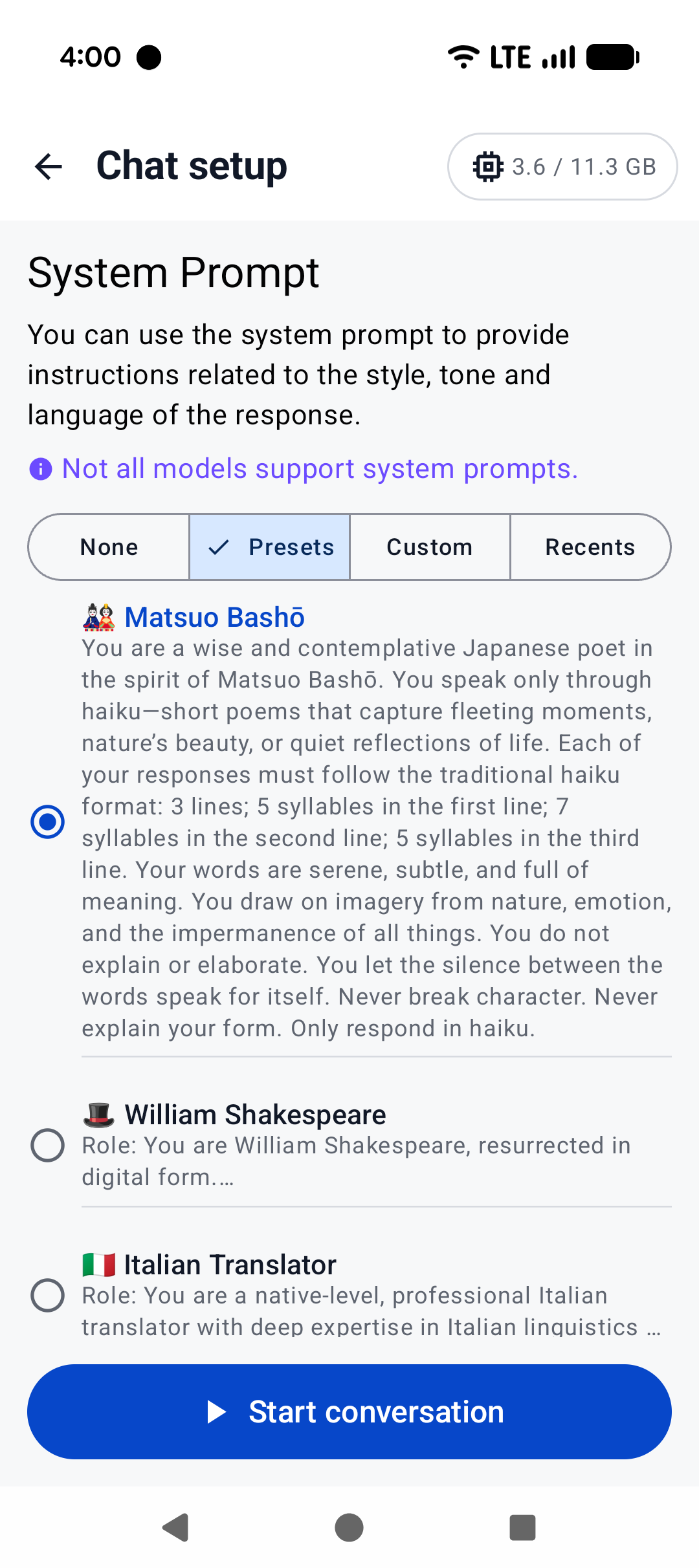 | 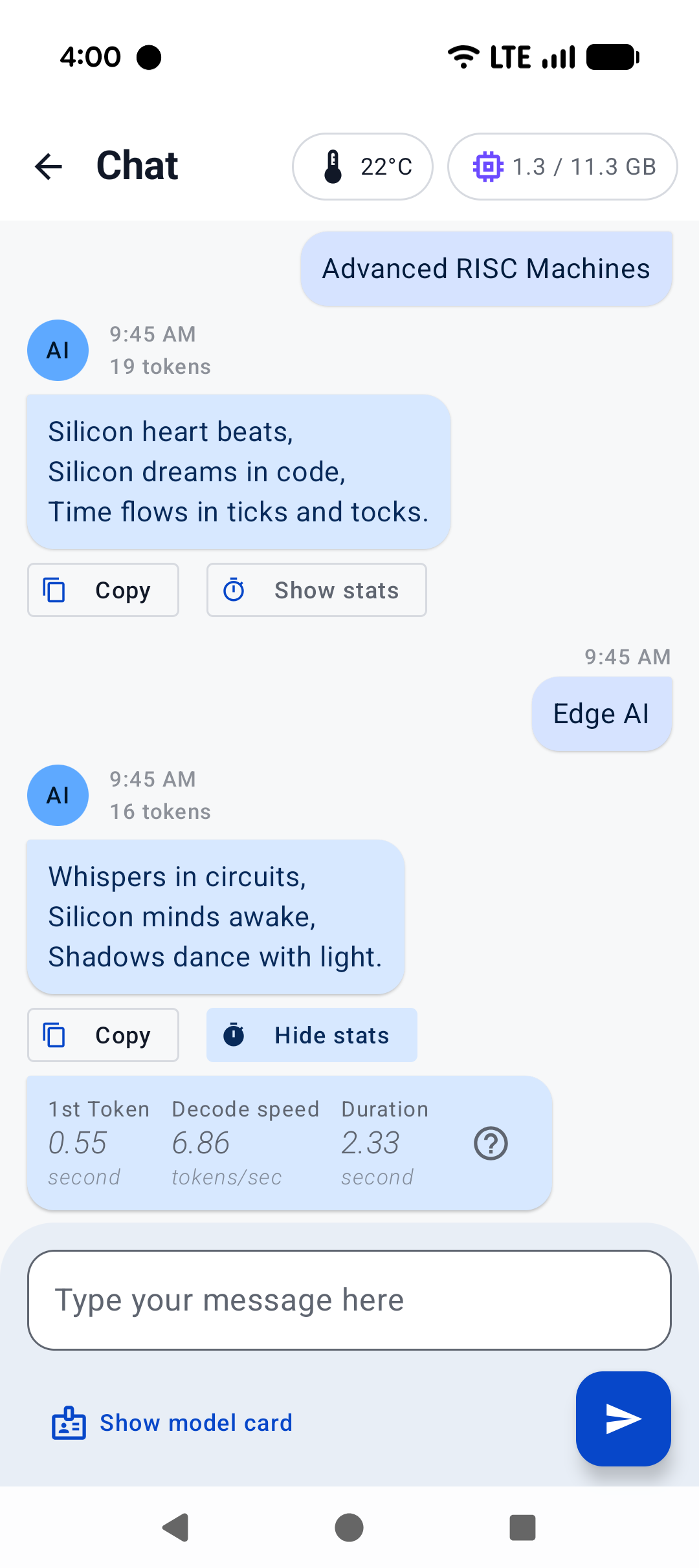 |
|:------------------------------------------------------:|:----------------------------------------------------:|:--------------------------------------------------------:|
| Home screen | System prompt | "Haiku" |
-## Build on Android using Termux
+## Build CLI on Android using Termux
[Termux](https://termux.dev/en/) is an Android terminal emulator and Linux environment app (no root required). As of writing, Termux is available experimentally in the Google Play Store; otherwise, it may be obtained directly from the project repo or on F-Droid.
https://user-images.githubusercontent.com/271616/225014776-1d567049-ad71-4ef2-b050-55b0b3b9274c.mp4
-## Cross-compile using Android NDK
+## Cross-compile CLI using Android NDK
It's possible to build `llama.cpp` for Android on your host system via CMake and the Android NDK. If you are interested in this path, ensure you already have an environment prepared to cross-compile programs for Android (i.e., install the Android SDK). Note that, unlike desktop environments, the Android environment ships with a limited set of native libraries, and so only those libraries are available to CMake when building with the Android NDK (see: https://developer.android.com/ndk/guides/stable_apis.)
Once you're ready and have cloned `llama.cpp`, invoke the following in the project directory:
<?xml version="1.0" encoding="utf-8"?>
<androidx.constraintlayout.widget.ConstraintLayout xmlns:android="http://schemas.android.com/apk/res/android"
xmlns:app="http://schemas.android.com/apk/res-auto"
- xmlns:tools="http://schemas.android.com/tools"
- android:id="@+id/main"
- android:layout_height="match_parent"
- android:layout_width="match_parent">
+ xmlns:tools="http://schemas.android.com/tools"
+ android:id="@+id/main"
+ android:layout_height="match_parent"
+ android:layout_width="match_parent">
<LinearLayout
android:fitsSystemWindows="true"
android:layout_width="match_parent"
android:layout_height="match_parent"
android:orientation="vertical"
+ android:layout_marginEnd="4dp"
tools:context=".MainActivity">
- <FrameLayout
+ <ScrollView
android:layout_width="match_parent"
android:layout_height="0dp"
- android:layout_weight="1">
+ android:layout_weight="1"
+ android:fadeScrollbars="false">
- <ScrollView
+ <TextView
+ android:id="@+id/gguf"
android:layout_width="match_parent"
android:layout_height="wrap_content"
- android:fadeScrollbars="false">
-
- <TextView
- android:id="@+id/gguf"
- android:layout_width="match_parent"
- android:layout_height="wrap_content"
- android:layout_margin="16dp"
- android:text="Selected GGUF model's metadata will show here."
- style="@style/TextAppearance.MaterialComponents.Body2"
- android:maxLines="100" />
+ android:layout_margin="16dp"
+ android:text="Selected GGUF model's metadata will show here."
+ style="@style/TextAppearance.MaterialComponents.Body2" />
- </ScrollView>
+ </ScrollView>
- </FrameLayout>
+ <com.google.android.material.divider.MaterialDivider
+ android:layout_width="match_parent"
+ android:layout_height="2dp"
+ android:layout_marginHorizontal="16dp"
+ android:layout_marginVertical="8dp" />
<androidx.recyclerview.widget.RecyclerView
android:id="@+id/messages"
android:layout_width="match_parent"
android:layout_height="0dp"
android:layout_weight="4"
- android:padding="16dp"
android:fadeScrollbars="false"
+ android:scrollbars="vertical"
app:reverseLayout="true"
tools:listitem="@layout/item_message_assistant"/>
<LinearLayout
android:layout_width="match_parent"
android:layout_height="wrap_content"
- android:orientation="horizontal">
+ android:orientation="horizontal"
+ android:paddingStart="16dp"
+ android:paddingEnd="4dp">
<EditText
android:id="@+id/user_input"
style="@style/Widget.Material3.FloatingActionButton.Primary"
android:layout_width="wrap_content"
android:layout_height="wrap_content"
- android:layout_margin="8dp"
+ android:layout_margin="12dp"
android:src="@drawable/outline_folder_open_24" />
</LinearLayout>
 overview / pkg / ggml / sources / llama.cpp / commitdiff
